Showing posts with label Global Entertainment Corporation. Show all posts

Thursday, July 26, 2012

Global Entertainment's Decade Of Bad Business: Part 5 Goes To Independence, Missouri

Over the past few weeks, OSG Sports has investigated the history of Global Entertainment as a vertically-integrated vision to medium-sized markets to build arenas- to varying degrees of success (and mostly varying degrees of failure). The reason for the attention: They've been consulting with the folks in Glendale, Arizona (home of the Phoenix Coyotes--for now).

Global comes to each proposed city with an idea and the idea of controlling every aspect of operation- from construction to ticketing and food complete with anchor tenants and promises of big-name acts brought in from other arenas booked in the Global chain...

In the ten arenas Global Entertainment was part and parcel to, in only one do they have a lasting relationship to date...

Part 1 introduces you to Prescott Valley

Part 2 introduces you to Allen, Texas

Part 3 introduces you to Dodge City, Kansas

Part 4 introduces you to Rio Rancho, New Mexico

The Independence (MO) Events Center (pictured, thanks Missouri Comets)
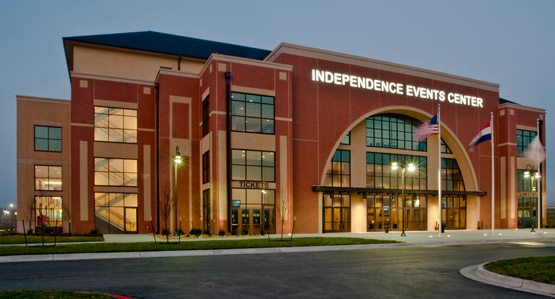
opened in November of 2009 at a price tag of $68-million. It was the eighth of ten buildings that Global Entertainment was party in developing. Sink Combs was involved as the architect for the fifth time in a row. Two anchor tenants are in place at present- the CHL's Missouri Mavericks (in keeping with the Global model of bringing in anchors) and the Major Indoor Soccer League's Missouri Comets.

The idea for the purpose of the Events Center is different than the previous cities that OSG Sports has investigated to date. While other arenas in Global's portfolio were meant to be integral to encouraging city development, the Independence Events Center was meant to be only a part of the core development at the intersection of Interstates 70 and 470.

"We already had significant development there with a regional mall and a Bass Pro Shops retail store outlet,"
Independence City Manager Robert Heacock said.

"We wanted the building to be the cherry on the sundae."

Independence had done due diligence through feasibility studies that reinforced the idea an arena should be in the market, but their funding would be different from the other cities that were studied.

"Our situation was unique in that we had seen other cities try to fund the arena through debt service and operations, but that didn't seem to be a tenable goal for us. What we could do through Missouri state law was include it as part of a Community Improvement District. We could, then, charge a sales tax in that District of anywhere from a half-cent to one-cent (depending on the economy) to help pay for it."

Since the Events Center would only be one of four corners of a "trade area" the city could use the sales tax funds to cover the cost of constructing the arena and nothing else. Independence wanted the Center to pay for its operating cost and be a not-for-profit venture.

"And that was critical to our thinking for the building to be a success. We wanted it to be a nice 'family room' for the community,"
Heacock continues. "We didn't want it to be intimidating as a structure. We wanted it to be, as our mayor puts it, a 'memory-maker.'"

Independence thought, in their initial investigation, that Global could fill a need with the arena idea as they marketed it- especially bringing in, what would eventually be, the Mavericks franchise. Global's role, initially, would include constructing the building. But the city of Independence would re-tool that into more of an advisory capacity over time. It was originally set for Global to manage the arena once it was completed, but after ten months the two parted ways.

The "GetTix" ticketing arm of Global was not proving to be successful in its function, either. The city took over control and handed it to Ticketmaster, which has proven to be more to the city's liking. That was only one conversion of Independence's role as they went on to form an LLC to run the Center and, eventually, the non-profit.

"The team Global hired to run the arena is still there," Heacock said. "We didn't want to try and develop that kind of expertise in-house or bring it over from the Parks Department."

After seeing the issues that Global had in the Youngstown, Broomfield, and Prescott Valley (more on those cities in later installments of the series), Independence thought they should have a reserve of $500,000 in place to off-set any kind of loss during the first years of operation.

"They admitted that managing buildings wasn't in their wheelhouse,"
Heacock says. "They were getting away from the day-to-day operations of arenas. There just wasn't any clear value to continue the relationship. While we were building the Events Center, we educated ourselves and identified some potential concerns. At the end of the day, it was best to part ways. There really wasn't a need for what they were providing."

Independence also felt it was awkward to have an Arizona-based company trying to run a Missouri-based arena. They felt it needed to be run locally. There was also a concern that arose in the marketing of concerts to the venue which- as part of Global's pitch- was that with all of the arenas they managed, the acts that were booked into one could be booked across the board.

That wasn't always the case...

"There was not enough return on investment to continue the partnership. But it was an amicable split."


Since the takeover of the Events Center by the city, Independence feels like the building has been managed effectively on their own. All the money the building makes stays with the building- to the point that this year, the city is projecting a $100,000 profit. The revenue streams are structured so that revenue goes into capital improvements if there is a profit on the books.

The advice from Heacock
: "Know what you're trying to accomplish with the facility and do your due diligence. Some view projects like this as a catalyst for development. For it to be successful, the building should have a role in economic development. There should be some synergy and support. It should broaden the viability of the trade area you're looking to have it in.

"It's critical to be clear on the economic expectations on the debt service and operations of the building. Without figuring out how we would handle the debt service here the way we did, it wouldn't have worked. It's a struggle when debt service and operations are intertwined.

"And you have to have a reserve in place especially for the first few years knowing it's going to be tough when you start."


Here's a story on when the Comets returned to life indoors to be client number two at the Events Center...
((HT: KSHB-TV))

Monday, July 9, 2012

Global Entertainment's Decade Of Bad Business: Part 4 Goes To Rio Rancho, New Mexico

OSG Sports continues its month-long investigation into Global Entertainment and their efforts, mostly failing, in the construction, operation, and vertical integration of ten mid-sized arenas in secondary markets- mostly in the mountain west portion of the United States.

When the ten arenas are analyzed, OSG Sports will look at the possible future of Global and a possible scenario for their future...

Part 1 Of The Series discussed their past

Part 2 Of The Series discusses the arena in Allen, Texas
Part 3 Of The Series discusses the arena in Dodge City, Kansas

"We got sold a bill of goods..."

The Santa Ana Star Center was the fourth of the ten Global Entertainment buildings to go on line in October of 2006, but this project seemed an uphill battle from its beginnings as a US$37-million, 8,000 seat complex.

The city of Albuquerque was in the process of developing an idea for a new arena to replace the aging "Pit." 15 miles away, the emerging suburb of Rio Rancho thought a new arena to draw traffic and, possibly, development would be a good idea under then-City Manager Jim Palenick. Palenick brought in Global Entertainment to help in the construction and operation of the building.

According to an Albuquerque Journal interview in 2011, former City Councilor Michael Williams said no marketing study was ever presented to the council:

“Palenick handled all that,”
Williams said to the Journal.

In an interview with OSG Sports, however, Palenick (now the Interim City Manager of Dallas, North Carolina) said he was party to tours of the Hidalgo, Texas Dodge Arena and the Covelli Center in Youngstown, Ohio and was impressed with Global's vertically-integrated approach:

"Their model was solid,"
Palenick said. "What they said they would provide was the design, financing, management, and most importantly, an anchor tenant in a Central Hockey League franchise. That is very important in a market that size. The series of arenas they managed in the mountain west made it to where you would look for traveling acts that you would be likely to book. They brought to the table what they said was an ability to book acts that were one day's travel away from the arena by bus."

After a loss of confidence, Palenick was fired in December of 2006 and wouldn't even be around for the fireworks. In 2007, there were very few events brought into the arena and concerts were even cancelled while the arena worked under a $250,000 loss.

Rosalie Rayburn of the Albuquerque Journal detailed how Global failed miserably from the start of the arena until their removal 27 months after the Star Center opened:

In a January 17, 2009 article Rayburn disclosed:

"...Global predicted the Star Center would turn a profit ($1.6-million). Instead, the 6,500-seat arena has had low attendance at events and numerous canceled concerts, and has lost more than $580,000 since it opened in late 2006.
 

The city has a big stake in the arena. It sold $36 million in bonds backed by gross receipts tax revenues to build the Star Center. During the past 18 months, the city has had to use more than $1.5 million in tax revenues to help make the bond payments."

Rayburn also wrote that Global was close to $43,000 in arrears to several clients at the time of their firing- almost $4,500 to two television stations, both 112 days past due, and over $11,000 to the Journal newspaper itself. And since local vendors had problems finding Global representatives, the bills had to be handed over to collections agencies in the attempt to get bills resolved.

"One of the other firms, we've talked to about running an arena presented it to me this way,”
Rio Rancho City Manager James Jimenez admits. “Take your operation cost plus your debt service and divide it by the number of operation days and that should equal what you think you need to generate per event. If we had done that, we would have found out that the building would have had to be subsidized for a long time- possibly forever."

Jimenez may be more right than he wants to be...

Annually, it appears that the city of Rio Rancho is on the hook for around US$3-million to keep the arena (pictured right, thanks Santa Ana Star Center) around and US$14-million since 2006 overall to do so. Jimenez hopes that the figures can be offset by event income and it will have to be that way for the foreseeable future. And the Star Center is looking for 115-125 dates a year.

These numbers fly in the face of what a Global spokesman said in 2008 when discussing the company's overall success and desire to add more venues to their portfolio in Yuma and Scottsdale, Arizona. In a November 2, 2008 interview with Joyce Lobeck of the Yuma Sun, Global spokesman Steve Bielewicz said that Rio Rancho lost money their first year, but is "now is doing much better. It's been in the black all year."

In the same interview, Bielewicz admitted that Global "always projects (buildings) won't make money the first year" and they "set aside a reserve."

That would be a news flash to Rio Rancho...

The Star Center would end up with the standard anchor tenant in the CHL's New Mexico Scorpions and, later, the D-League New Mexico Thunderbirds. But the Scorpions would only last for three seasons- the last in 2007-08 after attendance figures of 3,217 per game (14th of 17) in 2006-07, 2,979 in 2007-08 (13th of 17), and 2, 791 (12th of 16). Junior hockey and indoor football franchises would follow, but none would create enough buzz for profitability.

Here's the story from KRQE-TV when the Scorpions had to cease operations from July 2, 2009

"Our first goal is to meet 100-percent of our operational costs annually and be able to set aside money for capital improvements," Jimenez admits. "Will the building be profitable in five years...? Probably not..."

And Rio Rancho is a city that's caught in the in-betweens...

"What we need is a really unique anchor tenant and combine that with shows that are really family-oriented."

Jimenez admits that the Star Center is lucky to get three or four big-named concerts a year since his building is, an "odd size." Even in a half-house situation (3-4,500 tickets), the question has to be "Who draws in that range?"

There are certain acts that work like electronic music acts and comedians, but he's looking for that narrow niche to come into the Star Center and try and catch major acts as they're on the road somewhere in the Phoenix-Denver-Dallas triangle. The issue with that, he is finding, is tracking down a touring act that is available on a weeknight.

"We're lucky if we get a Friday night," Jimenez says.

The end result was a settlement of $100,000 on January 3, 2012. Rio Rancho had, initially, claimed that Global owed the city over $360,000 in unpaid bills involving everything from pest control to operation of the Zamboni for the ice surface.

Two weeks later when Global, in turn, sued for breach of contract to the amount of $500,000, the city of Rio Rancho responded in District Court with the following- once again from Rayburn and the Albuquerque Journal from August 20th where the City was:

"...countering that the Arizona company’s actions constituted fraud and negligent misrepresentation, which have caused the city financial harm.

...Global Entertainment presented inflated projections of the revenues it could generate from events at the 6,500-seat arena the city planned to build.

City officials relied on Global’s purported experience in the arena management business and these projections in deciding to proceed with the project.

Global Entertainment intentionally made “false representations” that were “unsound and wildly optimistic”

The principal on the Star Center is set to be paid off by 2027, but with interest the amount Rio Rancho will have been saddled with will be just under US$61-million for the US$35-million arena.

"What they (Global) proved over time," Palenick admits, "is that they cut corners and got rid of people. All the people that had the skills necessary to do the job left fairly quickly. They weren't skilled in booking acts and the people who were running the arena were barely a shadow of themselves. They couldn't prove they could do the job."

Palenick admits that an arena like Star Center has to come with a question of "What's the reason to do this?" It was set to be the cornerstone of a development that didn't exist. He also admits that for cities the size of Rio Rancho you have to do proper feasibility studies, be very conservative with financing, and make sure that an anchor tenant is going to be there for a long time- something the Scorpions were not.

The lesson from Jimenez: "Understanding your market... Not until Global Spectrum came in to help run the building did we understand the "guarantee" structure for musical acts. The biggest guarantee we ever put out there was for Zac Brown, and then we had to ask if we were going to fill our building while we were competing with an outdoor venue- the Journal Pavilion.

"You have to understand your alternatives and vet any proposal for any project like this. You have to figure out who is willing to operate as an agent versus any risk involved. No one was willing to come in here and operate on a risk basis. There were not going to be any guarantees..."

One last note from the city of Rio Rancho, Jimenez is set to retire Wednesday...

“On the agenda for Governing Body consideration (their 7/11 meeting) is a resolution conferring severance benefits to City Manager James Jimenez upon his retirement effective July 11, 2012. Also on the agenda is a resolution appointing City Attorney James Babin as acting city manager until a permanent city manager can be selected.

Both items noted above have to be voted on by the Governing Body on 7/11…”

Next up: An update on Global Entertainment and activity inside its home state...

Wednesday, July 4, 2012

Global Entertainment's Decade Of Bad Business: Part 3 Goes To Dodge City, Kansas

OSG Sports has spent the last month investigating a group that consulted with the city of Glendale, Arizona on their arena.

The motivation: Simple...

We got curious after we saw Glendale practically throwing themselves at any potential new owner for the Phoenix Coyotes. As many of you know, the Coyotes have all but gone out of business and have been run the past three years by the National Hockey League. All the while, Glendale has been paying the league $25 million a year to keep them where they are.

We wondered: Why are they paying so much to keep the team? Why did they offer to pay first Matthew Hulsizer and then others to take the team and keep them in Glendale.

The answer we found: A horrible arena deal that the city is on the hook for- and still is. And one other component became clear- someone with a track record of bad or failed stadium deals is associated with one of Glendale's current financial consultants.

For more reference, we suggest you read the first two stories in this series...

Part 1 In The Series On Global Entertainment
Part 2 In The Series On Global Entertainment

The following is Part 3:

By February of 2011, Global Entertainment was, for all intents and purposes put of the arena management and construction business. There was one building that was left for them to complete under a difficult economic climate.

The United Wireless Arena opened that month with a US$40-milion construction cost and a capacity of 4,500 permanent seats with another 2,000 possible attendees for concerts or any other event that could bring people to the floor of the arena.

The plans to bring the arena online were planned by the city of Dodge City as far back as 1997 when the "Why Not Dodge...? Sales Tax" was approved on a ballot that included construction of a race track and a youth complex that has softball and soccer fields.

Global Entertainment contacted the city when the idea of the Arena and Events Center was being established in the design, construction, and management phase. Global was appointed the Project Manager and was there during the design phase, according to Dodge City Manager Ken Strobel.

Dodge City city officials did their due diligence through visits to the Broomfield, Colorado and Independence, Missouri facilities that Global helped create and decided on an arena/10,000 square foot Convention Center model that could work for banquets and general meetings.

Global's normal model of vertical integration was discussed where all prospective employees would be all Global's and the commission and fees structure would have been relatively the same as the other nine arenas. But before the arena came online in February of 2011
(pictured right, thanks United Wireless Arena), the company backed out.

"When it got to the construction and the opening,"
Strobel admitted, "Global said they were not going to continue in arena management and they would just concentrate on design and construction. We started with two separate contracts with them in construction and management and we just terminated the contract."

Here's a story from KSN-TV in Wichita when the building opened- with ice...


"They did a good job for us," Strobel said. "But we had a seamless transition to VenueWorks out of Iowa who runs 25 to 30 buildings in the central United States."

Global went on to report their financials after the first quarter of its fiscal year 2011, which ended on August 31st. The company reported a net loss of $600,000 during the period compared to a net loss of $200,000 for the same three-month period two years earlier.

The company had declining revenues in the same period- which would make sense considering that the Dodge City facility was the last in this category that Global was involved in. They had only $1.8-million in revenue compared to $2.4-million in the same time period with three facilities in play- Wenatchee, Washington, Independence, and Allen, Texas- with Dodge City in the wings. Global said in a news release at the time that lower revenues in management and licensing fees caused the dollar drop.

Strobel will be the first to admit that the Dodge City situation is more unique than the others. A perpetual sales tax, "sizable" cash in their bank accounts, and the combining of the bonds from the race track and new bonds in the $40-million Events Center gave the building more solid footing than most other buildings in Global's dossier. According to the Wenatchee World (WA) newspaper, the city also expects to spend $500,000 in subsidies to keep things moving.

Another unique aspect of the Dodge City arena is the ice surface. Knowing that they're the only game in town for 30-40 miles, the rare commodity is leading to very popular recreational skating and the idea of starting a youth league. No minor-league franchise, per the Global model when they enter a relationship, is on the books at present.

"We don't have to have the ice surface," Strobel says. "But it adds an amenity to it that's unique to west Kansas. That was our attitude toward it."

The building hosts 6 to 8 concerts a year currently, and there is a lot of Convention Center activity ranging from Rotary meetings to conventions and weddings to state government sessions.

The lesson from Strobel: "Measure your market and look at your community needs and see what the support will be there for. Know your services in a challenging marketplace.

"You have to make the decision that 'You're only going to do this once,' so don't scrimp and pinch pennies. Do it right. The Events Center has been well received and it does have that 'wow' factor with the ribbon boards. We're working with VenueWorks to get more events scheduled."

The bonds issued on the building were 20-years when the building was born two years ago. Strobel says that paying off the facility will depend on how the sales tax holds as to whether or not the building can be paid off early.

So, with Dodge City on line, Global claimed to be out of the arena management aspects of their business- focusing on design and construction.

Next Up: Another of the ten arenas Global put on the landscape that is struggling financially... there are only eight others to talk about...

Wednesday, June 27, 2012

Global Entertainment's Decade Of Bad Business: Part 2 In A Series Visits Allen, Texas

Here's Part One of the Series on Global Entertainment...

Over the next editions here, OSG will recap Global’s business activities, expose the lessons each of their failed business elements, and try and determine where the future is with all involved.

Global Entertainment is a multi-layered business that seemingly focuses on consulting, building and then running arenas, mostly for smaller-to-medium size towns.

Their most recent foray into that business is consulting the folks in Glendale, Arizona.  The track record so far, is not very good.

They've left a virtual wasteland of failed management and cities with nearly empty and debt filled arenas.

Through interviews with city officials and scouring through documents, we learned how and where they've failed.

The first location is Allen, Texas- one of the places where the phrase “discovery phase” is currently in play...

They come to you with the idea of a shining star of a centerpiece- a mid-sized arena to help with a city's development- and Global would provide all the pieces to help with operation: connections to architecture, event planning once the arena is built, ticketing, food services, advertising, suite sales, and even anchor tenants since one of the vertical properties is the Central Hockey League.

But since 2003, Global has had their hands in the building of ten arenas- all of them have experienced some kind of failure with the company at the wheel.

The Allen Events Center (pictured right, thanks grisak.com/WFAA-TV) opened in November 2009 as the ninth of the ten arenas Global put on the landscape. The 7,500 seat building came on line at a cost somewhere between US$52-56-million.

The Central Hockey League agreed to put a franchise, the Allen Americans, in as an anchor tenant for a ten-year guarantee. Allen city officials visited three other Global arenas including the 1st Bank Center in Broomfield, Colorado and Tim's Toyota Center in Prescott, Arizona since the appointed architect would do the proposed Allen building as they had done the others.

The Events Center would be operated at no cost to the city and Global would make up any deficits according to Allen City Manager Peter Vargas in a conversation with OSG Sports. The construction and raising of the building "went great" according to Vargas:

"In their original model,"
Vargas explained, "they (Global) said that since they operated five or six other arenas they could book an act into each venue. It looked like a really positive model. But not long after, it was clear that they didn't have the financial wherewithal to run the arena. While the hockey team was a great tenant and puts on a great product, the rest of the balance wasn't doing very well."

While Global was supposed to also receive a $175,000-a-year fee (WFAA-TV reported in August 2010 that the figure was just north of $200,000) to manage the arena, the city of Allen knew there was a problem when Global couldn't meet payroll expenses and asked the city to help out in that regard.

Allen seems to be the exception rather than the rule in Global's case. Global was removed by June of 2010 as operator in favor of the city running the building, and the city had signed eight separate contracts for all of their bill paying for the arena cost. The building is still having issues being profitable.

The city of Allen has filed a lawsuit against Global within the last eight months and the suit is in the discovery phase. Vargas anticipates it will take a couple of years before the case is heard in court, and that mediation might even be considered first before any of the Allen complaint is heard...

The lesson from Vargas: "Have a substantial reserve before you establish the facility and understand that it will take, at least, three years before a totally new building will be accepted within the artist's community. In the day-to-day management of the arena, they (Global) tried very hard, but it became pretty clear that they didn't know how to run an arena."

Next: More evidence that Global has anything but "The Midas Touch". 

Monday, June 25, 2012

Friends Of Glendale's Money Consultant Has History Of Bad Business Deals: Part 1 In A Series

What if a company and/or businessman with a proven track record of failed business plans for arenas all over the country approached you and said: "Let us help you come up with a plan for an arena that we can make profitable for you...?"

OSG Sports found just such an arrangement/deal in place in of all places--Glendale, Arizona- where as many of you know, the city is in dire straits trying to cover the cost of an arena for a hockey team that can't afford to be there... and has spent, what some will easily call, good money after bad...

With the current referendum ideas on the tale in Glendale, Arizona, OSG Sports decided to look at the depth of the city’s proposed arena deal with Greg Jamison and see if the decisions that need to be figured out by early July could be the next step in a dangerous process with a potential partner down the line... Global Entertainment...

The plan that Global Entertainment lays out for prospective cities is fairly brilliant in its vertical integration. The company, based in Glendale itself, claims it can handle the burgeoning market for mid-sized arenas and all aspects of operation with their subsidiaries:

The Central Hockey League provides an anchor tenant
International Coliseums will build the place
Global Entertainment Marketing Systems will market the arena to clients
GetTix.Net is their version of Ticketmaster
Global Properties and Encore Facility Management run the place and
GEC Food Service will give ticketholders something to eat while they’re there…

As a business-sized taxpayer for the city, the two issues that are in the process of being settled by an economically-strapped city affect them twice- and in a third manner that they are in the process of creating with their friends.

Other business leaders in the city are in the process of gathering signatures to suspend at temporary .07-percent sales tax hike. Their deadline is July 5th. Business leaders maintain that it would add more unnecessary dollars that they are responsible for in their bottom line as the city is trying to find a way to pay Greg Jamison US$324-million over the next 20 years to run Jobing.com arena.

US$90-million of that would be paid to Jamison in the first four years of the proposed deal as the city of Glendale is trying to juggle city deficits, job cuts, and services being eliminated for taxpayers.

Civic leaders are looking at the deal as misplaced priorities and the Glendale City Council is looking at it as trying to keep the idea of an “arena as an oasis” above water.

But one of the parties giving advice to the City of Glendale in all of this political machination is TL Hocking and Associates. Hocking gave Glendale advice in the appraisal process as the city wondered aloud what the financial shortfalls would be without an anchor tenant in the Phoenix Coyotes NHL franchise. Hocking is also a co-defendant in a lawsuit with Global and its subsidiaries just up the road in the Prescott Valley, yet Glendale took their advice (at present) as economic gospel.

And continues to... until further notice...…

This activity lends itself to the thought that Hocking, and possibly Global, are looking to step their game up to the big leagues in the shadow of an activity that is still legally questionable. If Glendale’s voters come forward to revoke the city’s ideas to raise revenue and keep the city and its arena afloat in the coming weeks, then Global and its partners could be in the position to step in as a savior- with all its baggage and poor history of arena management.

Global Entertainment and their arena issues are nothing new as OSG Sports and others have investigated and disclosed in numerous venues.

OSG Sports has spent months trying to detail Global and Hocking's track record of failure over the past decade. This is the first of several reports on that. We'll take you to smaller and medium-sized markets all over the country where they are now saddled with millions of debt on arenas that were promised tenants and business that never actually were delivered. And Global was either asked to leave or left, and each city is still trying to figure out just how much damage has been done...

Allen, Texas is one of those cities. And after getting in bed with Global, they are heading towards a showdown.

That showdown is going to take place...in court.

Wednesday, June 6, 2012

Greg Jamison Better Not Agree With This In Glendale... Part 2 In A Series... (UPDATED w/Jamison Problems)

Lisa Halverstadt and Cecilia Chan filed another piece today in the Arizona Republic that says the HQ's initial analysis is pretty close to right...

A Republic analysis revealed that even if the Coyotes went to the Stanley Cup Finals for the next 20 seasons and the arena booked 30 sold-out concerts each year for the next 20 years, Glendale could still expect to lose about $9 million annually.

That figure does not include the city's annual arena debt payments, which will average about $12.6 million a year over the next 20 years.

Longtime Glendale Mayor Elaine Scruggs, who has said next year's budgeted $17 million arena management fee is too steep, said Monday she cannot support the deal.


Scruggs is also concerned that capital improvements won't be seen in the city (which has its ghost-town moments both commercially and residentially these days) for, at least, five years as Glendale itself is seeing its budget for the same thing decrease.

And this deal with Jamison would grant him something over the city's own needs...

Really...???

Another issue... TL Hocking and Associates...

Thomas L. Hocking is a former investment banker who knows his way around the idea of municipal bond financing. Hocking formed "TL Hocking and Associates, LLC" and partnered with Global Entertainment Corporation to promote the development of mid-sized event centers and arenas including one in Prescott, Arizona- home of the Central Hockey League's Arizona Sundogs in the 2000's. The Sundogs and the CHL are owned by Boston Pizza magnate James Treliving.

Treliving has been linked to the Coyotes sale, but has denied any involvement in a purchase- despite being linked by Canadian talk show host Bob McCown

As told by OSG hyah in May and hyah in April...

According to Halverstadt and Chan, Glendale Deputy City Manager Jim Colson said an analysis by TL Hocking & Associates (and paid for by the city) projected Glendale could expect to bring in an average of $15.7 million annually over a 20-year lease with Jamison and $6.5 million without the Coyotes.

From their article again...

A 2009 study the consultant completed for Glendale assumed all city sales-tax revenue the surrounding Westgate City Center and fees from the arena would halt if the team left, adding up to a $500 million loss for Glendale over 30 years.

But the team is losing ten million more than that by being around... and the city is still pouring more money over the idea that the Coyotes are the savior...

The problem... can Hocking be trusted since they were a party in a lawsuit brought forth against the city of Prescott in September of 2009 by Wells Fargo...? Fargo felt they were duped by an artificial rating of bonds used to build the Prescott Events Center.

In an 83-page brief filed in Arizona State Superior Court, Wells Fargo was looking to take all defendants to court because of what they called...

"...the negligent offering and sale of $35 million in face value of what were misrepresented to be “A-” rated, investment grade excise tax revenue bonds (“Bonds”) used to finance construction of a 5,000 seat event center in Prescott Valley, Arizona (the “Event Center”)."

((The Events Center is on the right, thanks timtoyotacenter.com))

Wells Fargo was also looking to claim sales taxes in the neighborhood of $1.2-million that were failed to be paid to them as a bonds Trustee by October 1, 2007. Wells Fargo claimed that certain information wasn't disclosed to them by a combination of the defendants saying that there was no way that the Prescott Events Center would ever generate the income it was claimed it would...

Retail Bondholders, reasonably believing that they were buying investment grade securities, purchased the Bonds in reliance upon recommendations from their brokers in many cases employed by the Defendant underwriters and/or upon review of the prospectus called a “Preliminary Official Statement”

Revenue was supposed to come from sales taxes from in and around the area of the Events Center that even included what was referred to as an "Entertainment District" adjacent to the Events Center and something called a "Secondary Credit Support Area"- which could be considered businesses not in the "Entertainment District," but close enough to be part of any revenue stream.

The HQ would like to ask if this is sounding the least bit familiar in the Glendale situation at present...

The feasibility studies, according to Wells Fargo's suit, had padded numbers for events in the venue- and the number hasn't been reached to date. Padded numbers for events led to padded numbers for return on the bonds and that would, eventually mean Prescott would not meet its financial obligations.

One of the 17 defendants, Global Entertainment Corporation, was referred to in the lawsuit as being operated by its directors- which included Treliving...

"General Allegations" in the suit included the following...

36. Global is a holding company established in April 2000 through a
reverse merger with the Western Professional Hockey League, Inc. In June 2001
Global negotiated a Joint Operating Agreement with the Central Hockey League
(“CHL”) and fielded sixteen teams using the CHL name. In November 2002
Global acquired International Coliseums Company (“ICC”) which was in the
business of designing, managing and operating multi-purpose event centers.
According to Global (Official Statements p. 27), this vertical integration provided
Global with, “the expertise to develop, design, build and manage multi-purpose
event centers.” Global also arranges the financing of event centers. At all times
pertinent to this Complaint, Global was directly and indirectly controlled by its
officers and directors, including Treliving and (Richard) Kozuback.

37. Global and Hocking seek to persuade communities that are not large
enough to attract major league professional sports franchises to build event centers
that will be anchored by a CHL hockey team or other minor league sports teams.
Global offers to develop, arrange financing, build and operate the event center.

38. Revenues from event centers are derived from the annual number of
events and the number of people who pay to attend those events. Net operating
revenues from event centers are a function of project revenues less operating
expenses. The amount of attendance at events depends primarily on the population
and number of households in the market area for the event center and disposable
income. The annual number of events an event center can attract also depends
upon the population and number of households in the market area. The amount of
sales tax revenues generated by an event center and surrounding businesses is also
dependent upon the population and number of households in the market area. The
economic feasibility of an event center that uses both operating revenues and sales
tax revenues to service the debt incurred building the event center is highly
dependent upon the surrounding population and the level of disposable income.


Once again, we'll assert that through Section 37 of the Wells Fargo suit that the Prescott situation is virtually the same as the Glendale situation- only possibly larger in scope if followed through since Hocking was directly involved in the Glendale appraisals.

Because the town of Prescott defaulted, in Wells Fargo's view, on two occasions in paying on the Events Center (delivering tax revenues and interest payments on schedule), they had no recourse but to file the lawsuit.

Fargo asserted that the defendants (including TL Hocking and Treliving) were party in artificially inflating the numbers in feasibility studies released in 2005 that reflected a (seemingly) magical 50-percent increase in activity to justify a $35-million bond to build the Events Center. A third-party was brought in to back up the appraisals and was, subsequently, not renewed when their numbers didn't mesh with the defendants supposed needs.

Leading to Section 109 of the Wells Fargo suit:

109. Global, Hocking, the Town, PVEC, PVSE and Fain Group had actual
knowledge that Global had substantially and wrongfully inflated the revenue, event
and attendance figures in the Official Statements over the projections contained in
the 2001 Feasibility Report and the 2005 Preliminary Feasibility Report because
they each received and reviewed the 2001 Feasibility Report and the 2005
Preliminary Feasibility Report.


The end claim by Wells Fargo was that the underwriters and the Events Center Authority, all acted negligently by issuing the bonds. They were also negligent since they "DRAFTED OR APPROVED DEFECTIVE BOND DOCUMENTS GIVING THE TOWN THE ABILITY
TO EVADE THE PAYMENT OF SALES TAX REVENUES." (ed. note- capitalization from header in the lawsuit wording)

Wells Fargo asserted in the suit that all defendants were in violation of the Arizona State Securities Act, were negligently misrepresented in this case, and claimed that the town of Prescott was in breach of contract.

And, if that doesn't set, another plaintiff- Allstate Life insurance Company- spun off to chase after the defendants themselves as part of a class action suit.

The second amended case was filed in 2010 in District Court in Arizona...

We're still looking for a resolution in either case...

These days, if you try and access Global Entertainment's website, you don't get anything but a dead link while the Sundogs were dead last in the CHL's Western Division.

Attendance figures have been the following since their entry into the CHL:

2006/07- 8th at 4,225 per game average
2007/08- 6th at 4,310
2008/09- 9th at 3,521
2009/10- 13th at 2,689
2010/11- 16th at 2,150
2011/12- 10th at 2,507

NB: Those are the attendance figures released by the league, so accept them as you wish...

The best we can figure, the HQ would like to equate all of this activity in the last three years to that of the duck and its walking and quacking- from Prescott all the way down Interstate-17 to Glendale...

If Greg Jamison is looking for a boondoggle or a massive tax write-off, he should take the deal with the City of Glendale. If he's a smart businessman, he runs away from the deal. It looks like there are too many shady folks out there looking for another run...

If the Goldwater Institute is watching, all of this may not get that far...

More when we know more...

Here's the video from FSArizona when the Sundogs hosted the CHL All-Star Game this season...


1600 UPDATE: According to a report from Forbes Magazine's Mike Ozanian, Jamison is having issues raising the $170-million.

Investors are coming to their senses and are having issues believing that the team could be profitable. Forbes gave the value of the Coyotes at US$134-million...